
Plan FF&E from the install date, not the order date
Most late items were late on the day they were ordered. Work backwards from the date each piece has to be on site and the risk shows while there is still time to act.
- Published by
- Techstyles
- Published
- Reading time
- 4 min read
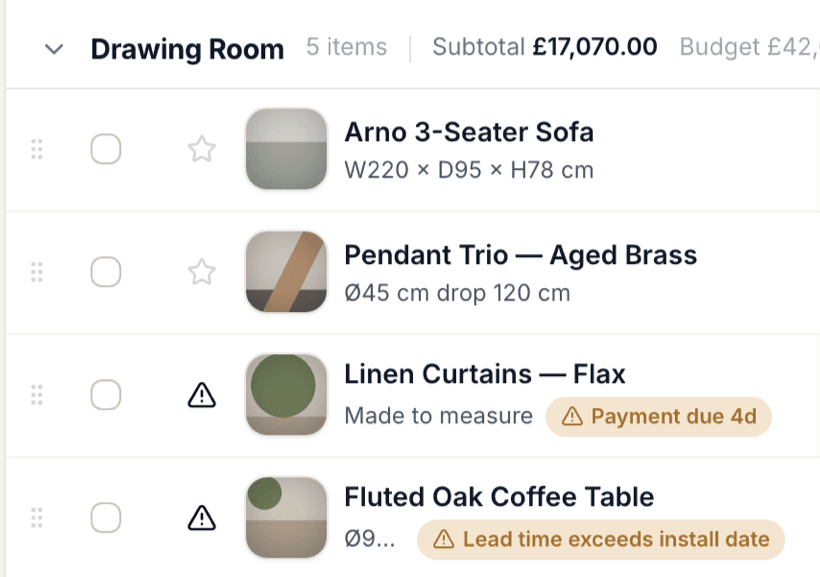
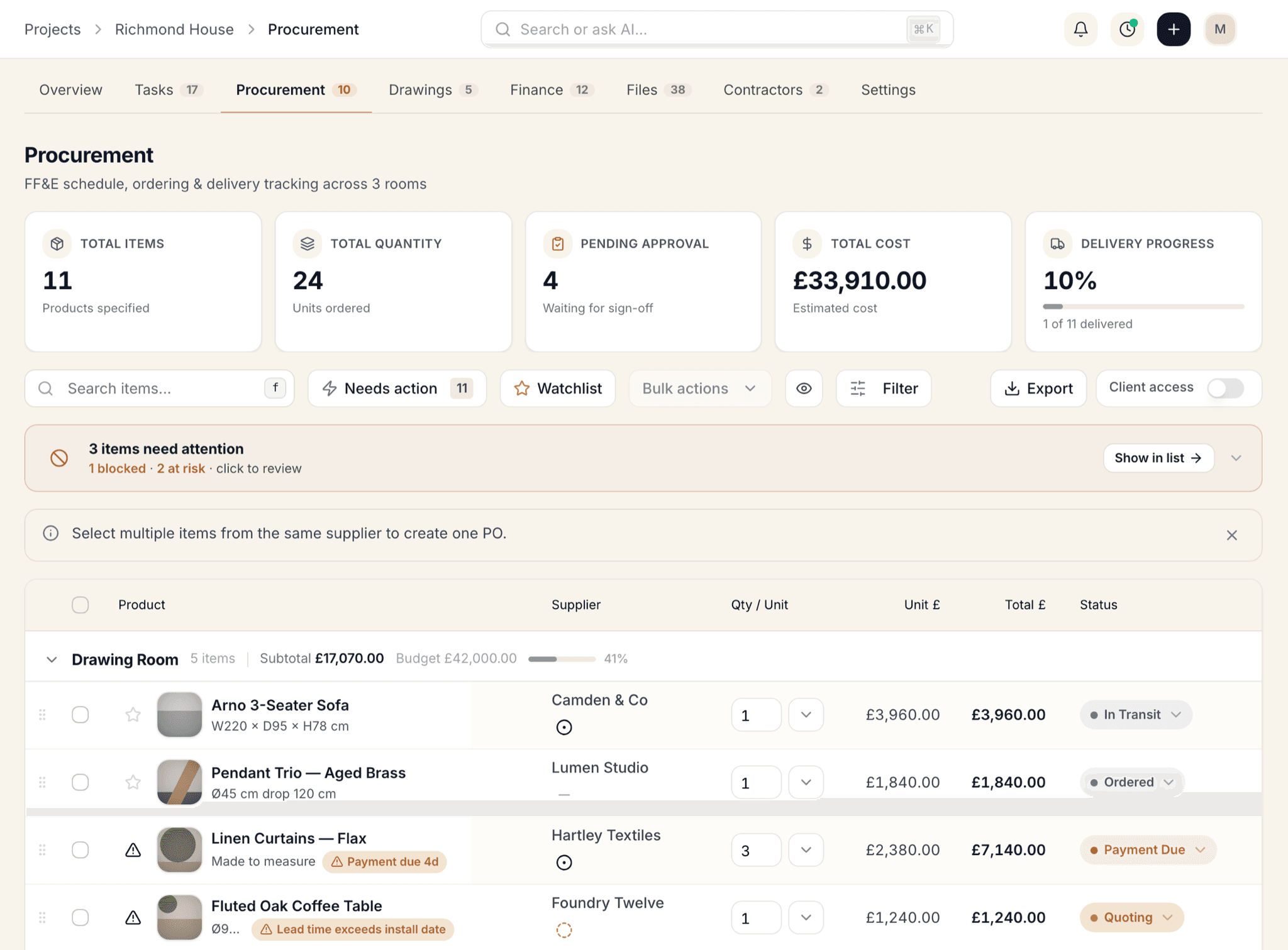
Every studio has a story about the sofa. Chosen in October, approved in November, ordered the week the client finally signed, and still in a workshop when the installers arrived. Nobody did anything wrong on the day. The item was late before it was ordered, and the schedule had no way of saying so.
The order date answers the wrong question
A procurement schedule that records when something was ordered tells you about the past. The question a project actually asks is about the future: will this piece be on site, checked and ready, on the day the installer needs it? The order date is one input to that answer. On its own it is not the answer.
That is why so many schedules look healthy right up until they do not. Every line says “ordered”, every line has a PO number, and three of them will miss the install by a fortnight.
Work backwards from the install
Start each line with the date it is required by: the install date, less the time you need to receive it, inspect it and hold it. Then take off the supplier’s lead time, and the time it takes to raise a purchase order and get the client to sign off the selection. What remains is the last safe day to commit. Past that date the line is at risk, whatever its status column says.
A worked example
Take an upholstered sofa with a twelve-week lead time, going into a drawing room that is being installed on 2 March.
| Step | Allow | Date |
|---|---|---|
| Install | Fixed | 2 March |
| Delivered, inspected and held | 1 week | 23 February |
| Supplier lead time | 12 weeks | Order by 1 December |
| Client sign-off and PO | 1 week | Selection agreed by 24 November |
The useful date on that line is 24 November. It is the one the client needs to hear, and it is three months before anything arrives.
A line is not late when it arrives late. It is late the day its last safe order date passes.
Score every line, every day
The arithmetic is easy. The difficulty is that a real schedule runs to a couple of hundred lines and the inputs keep moving. A supplier revises a lead time. A client takes three weeks to approve a fabric. The builder brings the install forward. A line that was comfortably safe on Monday can be at risk by Friday, and nobody re-reads two hundred lines every Friday.
So the check has to run on its own, against every line, every time a date changes. Each line is either on track, at risk, or already past the point where it can arrive in time. The schedule should say which, next to the item, without anyone having to work it out.
What to do with a line at risk
Flagging early is only worth it if there is still a decision to make, and there usually is. Confirm the lead time with the supplier in writing. Offer the client a substitute that is in stock. Re-sequence the install so the late room goes last. Or tell the client now, with those options in hand, rather than on the morning of the install. The earlier the flag, the more of these are still open.
Put the risk where people will see it
The risk belongs on the schedule itself, not in a separate report. When the designer opens the procurement list, the at-risk lines should be the first thing they see. When the client opens their portal, the selection they are holding up should say what it is holding up.
Where software earns its place
None of this needs anything clever. It needs the install date on every line, the lead time on every line, and something that does the subtraction every time either moves. In Techstyles each FF&E line carries its required-by date, and the schedule flags anything whose lead time will not get it there.
Automation helps most at the edges: pulling product details from a supplier page so the dates and prices go in correctly the first time, and keeping the schedule, the purchase order and the invoice in step afterwards. The judgement stays with the designer.
The sofa will still take twelve weeks. The difference is knowing it on the day you choose it.
Filed under procurement
Keep reading
More from the journal
Industry2 min read
Sustainable procurement: a designer’s guide to ethical sourcing
Sourcing responsibly without compromising the scheme or the budget, and making the sustainable choice the easy one.
Industry
2 min read
Clients2 min read
Client communication that keeps a project on track
How to keep clients informed and calm from kick-off to handover, without writing the same update every week.
Clients
2 min read
Business2 min read
Financial management for design studios: beyond hourly billing
Pricing by outcome, seeing margin while you can still change it, and protecting cash flow on procurement-heavy projects.
Business
2 min read
Get started
Know which items miss the install date
Techstyles scores every FF&E line against the date it has to be on site, in GBP, with VAT and a two-way Xero sync. Everything included, one price.
- Pricing
- Everything included. No feature tiers, no per-project fees.
- UK finance
- GBP and UK VAT, with a two-way Xero sync.
- Switching
- We move your live projects across for you.
Three months free. No card required. We move your live projects across for you.
Not ready yet?
See how install-date scoring works